You may notice that you have never seen video returned from a spacecraft sent to Mars. The explanation for this is not that we are unable to send a video camera to Mars. Instead, it is due to the fact that the current deep space network (DSN) cannot support the high data rates required for video streams. In preparation for future missions, which will likely require data rates on the order of Gbps, NASA is spearheading the development of a free-space optical communication system in which an earth based optical telescope listens to a weak optical signal eminating from a laser aboard a remote spacecraft. By encoding information in the timing of these weak laser pulses data rates in excess of 1 bit per photon detected are possible. In order for such a system to work, a large array of extremely sensitive superconducting nanowire single photon detectors (SNSPDs) must be efficiently coupled to room temperature electronics. The UMass RFnano group is currently developing sophisticated cryogenic integrated receiver circuits for this purpose. The goal of this program is to develop novel integrated circuits which enable the integration of 1,000+ pixel arrays of SNSPDs in a single cryostat.
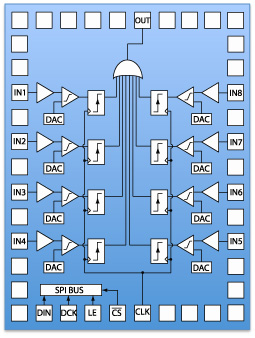
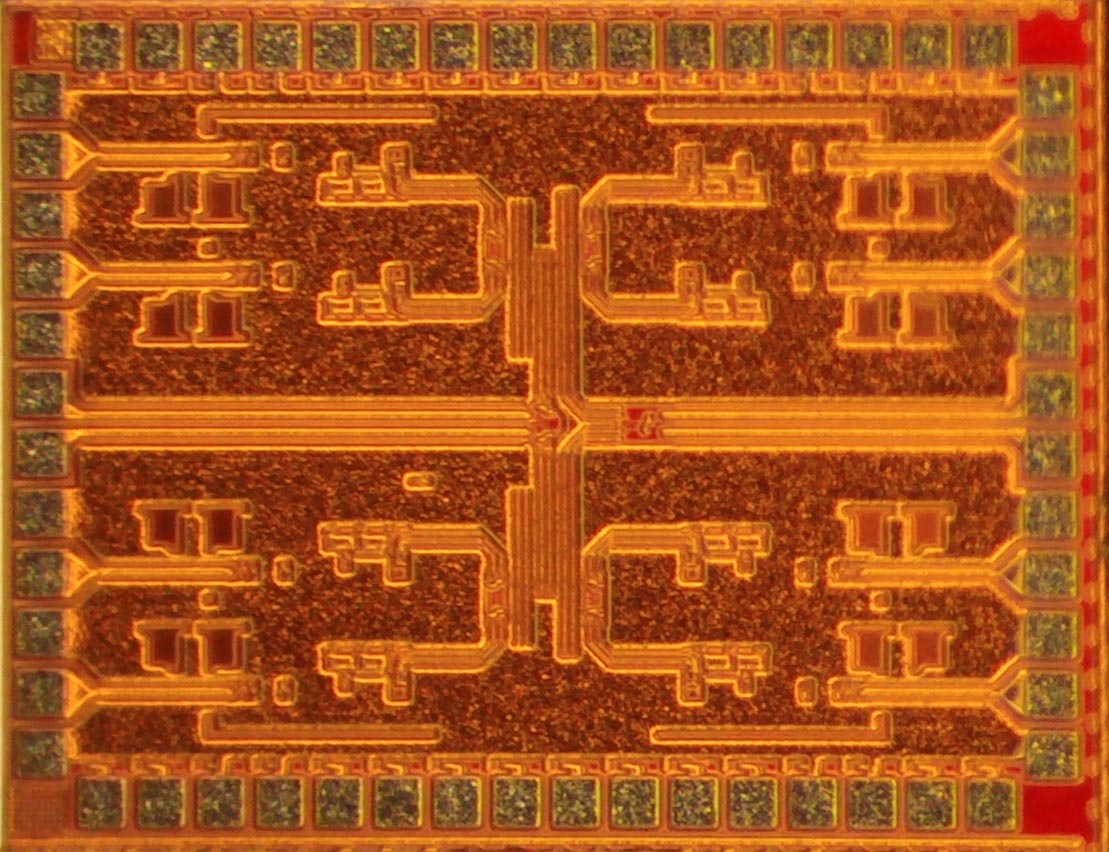
Eight-channel digitally controlled SiGe receiver circuit designed to interface to SNSPD array. The chip has been designed for operation at 50 K using custom large signal device models.